
The System For Opioid Overdose Surveillance (SOS)
Attention: SOS Users and Supporters
Thank you for your support and use of the Michigan System for Overdose Surveillance over the last 7+ years and helping us to improve it and make it what it became. Due to a combination of factors, we are moving the SOS dashboard away from its current technical setup (which is through the Michigan Medicine Health Information Technology Services (HITS) computer system).
We are currently working on the establishment of a new SOS dashboard within a different computing environment (e.g., an environment similar to that used for our recently released violence surveillance dashboard Mi-FINDS – Michigan Firearm Injury Near real-time Data System), with very similar resources to what the current SOS dashboard offers. Once a new dashboard is established, all current SOS users will be updated on an estimated launch date and invited to register. In the meantime, [email protected] will continue to be monitored, and we are happy to disseminate data summaries manually, per request, to the extent possible.
Please feel free to reach out to [email protected], with any questions or feedback.
Overview
Opioid overdose represents an urgent public health problem in the United States, with Michigan ranking among the states hardest hit by the dramatic escalation over the past 15 years. A key component of addressing this crisis is timely surveillance—and accompanying data analytics—that can be used to guide resource allocation used for rapid response and prevention.
SOS is a web-based tool that offers two level of access. The first level is public, and displays county-level summaries. The second level of access—which is available to authorized public health and public safety users across the state of Michigan —maps non-fatal and fatal opioid overdose incidents in near real-time, and provides demographic briefs. This interactive dashboard includes features that allow users to tailor visualizations to meet their specific needs. Users can select a data source, a zoom window, and a time frame to display points and descriptive summaries of suspected overdoses. Users can also toggle buttons to restrict the visualizations and summaries to only specific subsets (e.g., age groups). This previously unavailable tool is designed to inform data-driven opioid overdose prevention and response efforts with the goal of reducing overdose injuries and fatalities.
SOS was created through a partnership between the University of Michigan Injury Prevention Center and Michigan High Intensity Drug Trafficking Areas (HIDTA).


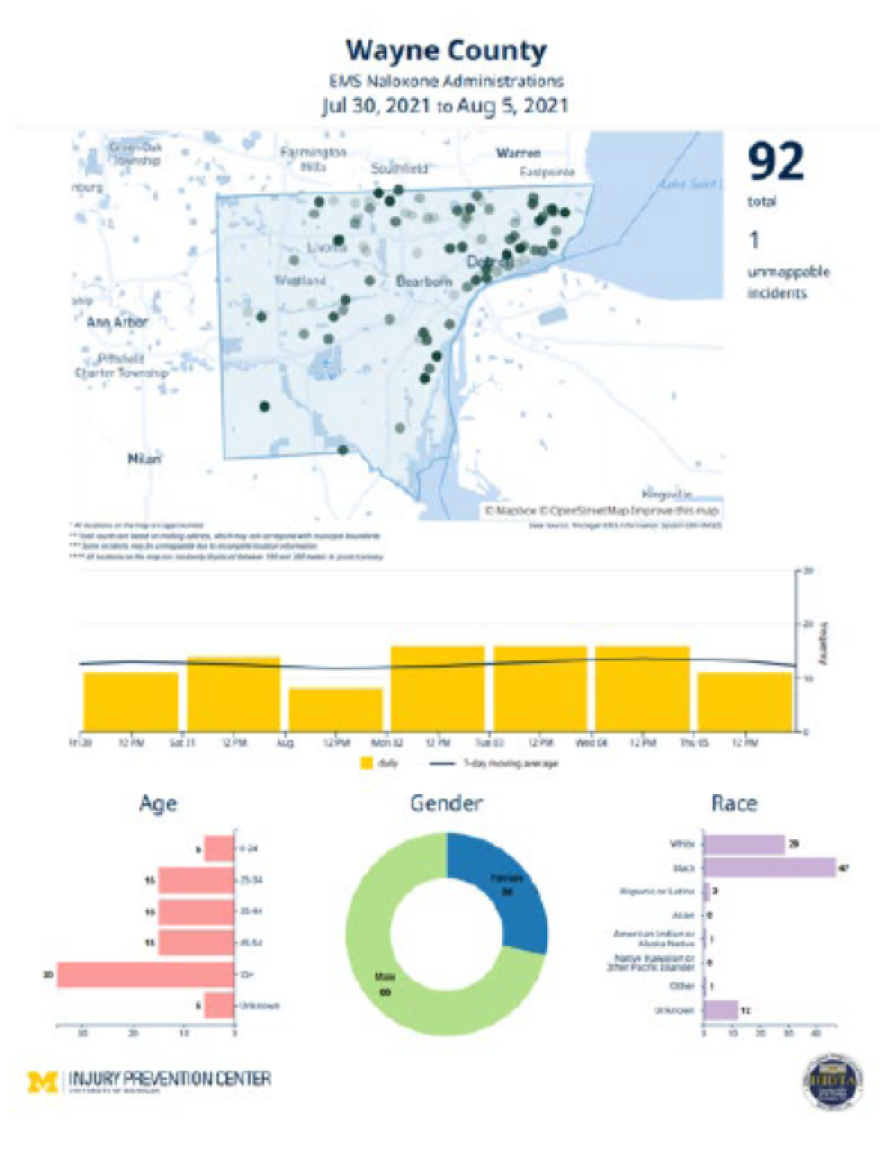

Community Overdose Response Toolkits
Three unique guides detailing actions communities can take to strengthen their coordinated community responses to opioid overdose, using data from the System for Opioid Overdose Surveillance (SOS).
Contact Us
Please email [email protected] with any questions.